
Task Force Begins Weighing Future of Hendricks County Courts
A task force studying the future of Hendricks County's judicial facilities focused on a question that will shape county government and the Town of Danville for decades: Should the county build a new judicial center on its East Campus near the jail, or keep the judicial facilities in downtown Danville?
The task force is comprised of representatives from the county council, county commissioners, each county judicial department, the county clerk's office, the towns of Avon, Brownsburg, Danville, and Plainfield, downtown Danville property owners, the Danville Chamber of Commerce, and The Republican.
The discussion was led by County Commissioner President Dennis Dawes and Eric Weflen with Studio View Architecture. Studio View presented two possible scenarios for how a new judicial center could work in downtown Danville, and one scenario for how it could work at the East Campus. Dawes said county officials will eventually have to determine the best long-term solution for both county government and the community.
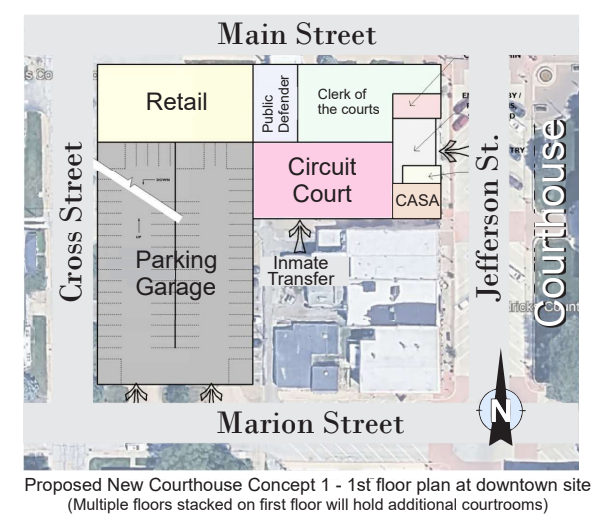
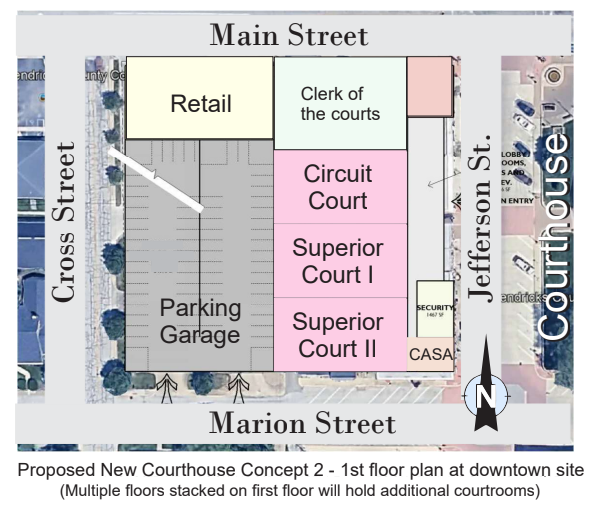
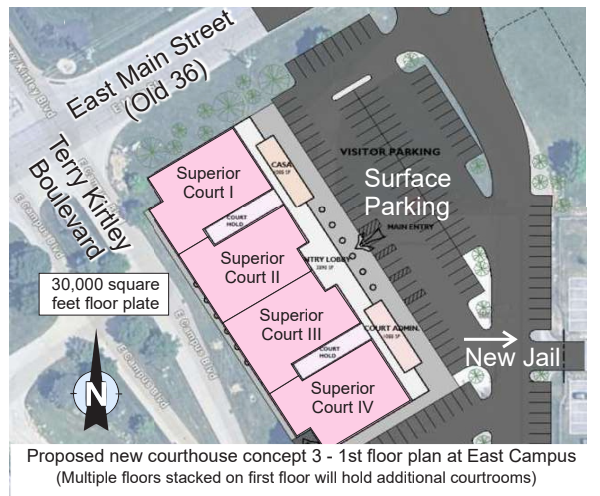
Once all three scenarios were presented, the group began an open discussion on the pros and cons of each scenario. Regarding the two downtown concepts, the first Danville plan utilized only the properties currently owned by the county. The second plan included the purchase of privately owned properties at the southwest block of the square to the existing properties.
The East Campus concept showed a new judicial center building adjacent to the new jail.
To keep the judicial center downtown and to allow for expansion for up to 12 courts in the future, buildings on the west side of the square would have to be at least six stories tall, and a parking garage would need to be built behind the buildings.
County Council member Eric Wathen feels the best scenario for the taxpayer would be for the county to enter into a public-private partnership with a developer to expand the judicial center in the downtown area. “The thought Brad [Whicker, county commissioner] and I had is having a developer come in and do this. The county rents the bottom spaces from them and they have apartments above it. Just because it's the same building, none of the entrances would be the same, nothing would be the same, it'd basically be a separate building sitting on top of this (building) with apartments, so there'd be no issues with safety,” explained Wathen.
Danville traffic is a concern expressed by county Chief Public Defender Jeremy Gooch. “I've been out here since 2002 in a private capacity and now working for the county for the past nine years. What I've noticed, no disrespect for Danville, all respect for Danville. You have an infrastructure problem when it comes to 36 being your main artery coming into this town. I've always heard talk from bypass that never seems to happen. It seems to go different ways.”
If the judicial functions were to move out of the courthouse, Commissioner Dawes suggested that other county government offices could be relocated to the courthouse including the health department, voter registration, planning and zoning, treasurer, auditor, assessor, recorder, etc.
However, the current condition of the courthouse is such that Dawes said, “Even if we did nothing, we're going to have to put several million dollars into that courthouse just to make it functional now, because it's not working well, it needs a lot of work, and so what could we put in that building that would keep things downtown that wouldn't have to go to East Campus. Where the prosecutor offices are on the west side of the square, that whole building could become an area for public development, then that would even go back on the tax rolls.”
Most of the group felt a judicial center at the East Campus would provide the safest choice for the public and county staff. The building would be designed to have the probation and prosecutors’ departments in the same building as the courts and the clerk of the courts. This would allow not only for safe separation from potentially violent criminals but also a more efficient process for all judicial departments to cooperate. The East Campus would also allow for easier expansion of the county’s judicial services.
Economically, what happens to downtown Danville if the courts move? That unknown is concerning for Danville town officials and local property owners.
Scott Lingle is currently working on opening a midscale restaurant on the square and suggested the county be open to incentivizing economic activity of some kind to help mitigate any economic concerns if the courts move. One suggestion was that the county could help financially with building a parking garage in the downtown area.
Wathen pushed back, saying, “If we're moving a bunch of our employees out of downtown, there's no incentive for the county to build a parking garage down here. I don't know why we would, if we're moving 100 employees out of downtown, why would we build a parking garage?”
No decisions were made during the meeting. Instead, members agreed that additional information is needed, including cost comparisons, potential economic impacts and examples from other Indiana communities that have faced similar decisions. Dawes said the task force will continue gathering information before making recommendations to the Hendricks County commissioners, who will ultimately decide the future location of the county's judicial system.